
Group D soils here are commonly clayey and can have high shrink-swell potential, so the soil around the roots changes as conditions change. Our assessments read that ground along with the tree.
Soil under Wichita trees
Expansive clay in the river valleys raises heave risk, and on group D ground the soil itself changes volume as conditions change. Much of the area is Penalosa, a well-drained silt loam, but a yard can still sit on a different soil than the one behind it. We account for changing ground whenever we work around roots, lawns and hardscape.
A crown that looks fine can be sitting on ground that has changed. When the question is whether to prune or take weight off, we weigh what the root zone is doing before we decide the crown is the problem.
Many projects also need tree removal. Shopping for tree service in Wichita? Our home page has more.
Before you book: Tree Service Step by Step: What the Job Involves · Comparing Tree Service Quotes: What Is Worth Checking
A 360 walk, and what goes in writing
We inspect from the ground and walk a full 360 degrees around the tree, not just the side facing the house. We start at the buttress roots where the trunk meets the soil, then work up the trunk, along the branches and into the crown. Binoculars come out for the upper structure, and a mallet comes out where the trunk needs a closer check.
We also write down the site conditions that could affect how likely the tree is to fail: slope, soil changes across the lot, and changes in nearby tree cover. If a neighboring tree or a stand of trees is gone, that goes in the record along with the tree itself.
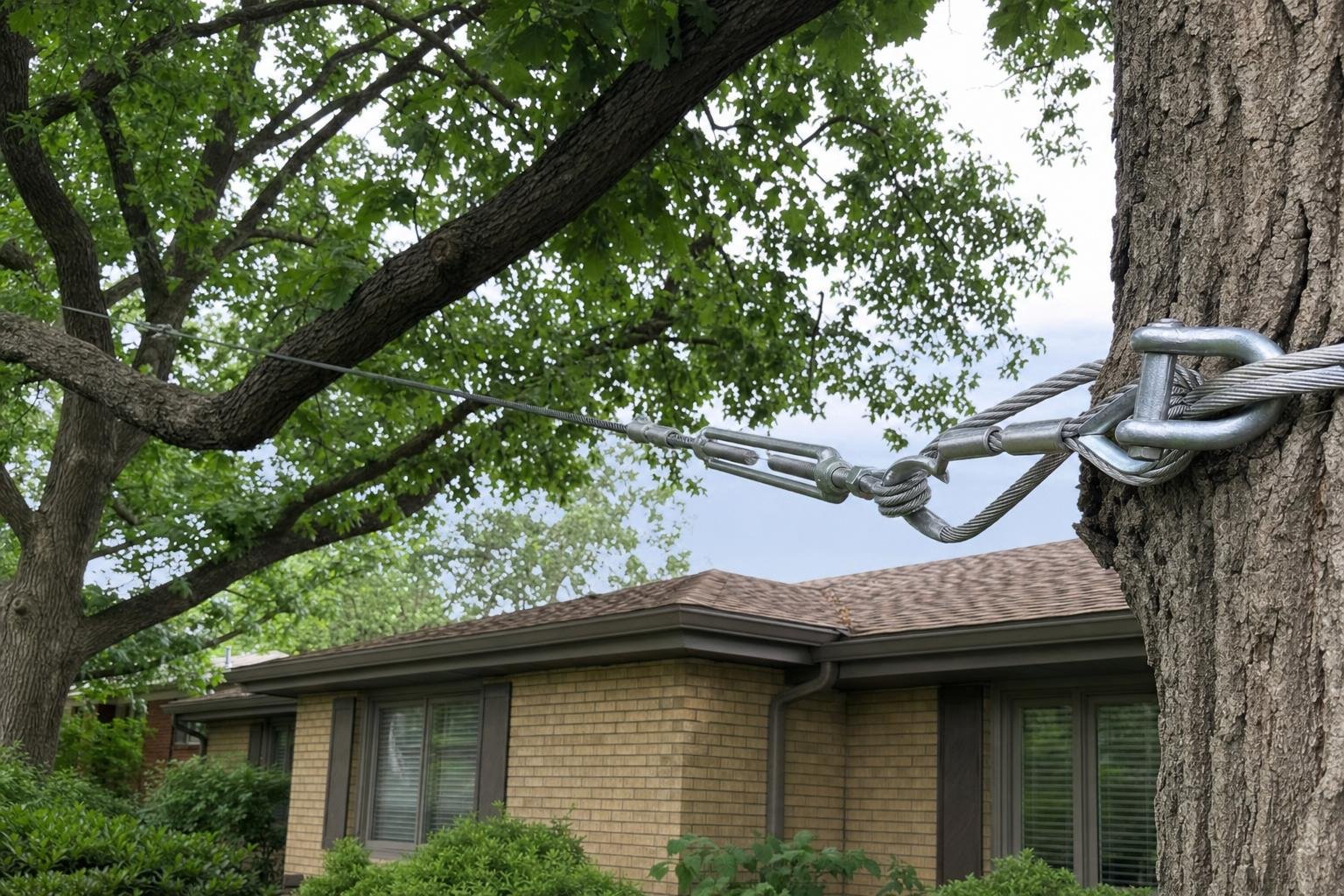
If the crown needs work, we'll say so, and that's a job for our tree trimming and pruning crew. If the trouble is in the soil or the root zone, a trim won't fix it, and the report says so.
Foundations and building rules
Wichita adopted the 2018 International Residential Code, with local amendments, for one- and two-family homes. Those rules refer builders to local foundation, basement and slab-on-grade standards, so don't assume every house has the same foundation arrangement. Before we say anything about a tree near a house, we look at what the house is sitting on.
When a tree is close to planned construction, the roots and the foundation are competing for the same ground. An addition, a garage, a new driveway or a pad can change drainage across a lot, and the tree responds. We document the tree's condition and the site before anything gets dug, so the people designing and building are working from what's actually there.
Construction-related report cost
A construction-related arborist report runs $350 to $900. A typical range like that is something we can give you on the call, and the exact number is set after we've seen the site.
Where it lands depends on how much we have to walk and record. Every one of those site conditions goes in the report, so a lot with several of them takes more time than a flat one with a single question to answer. If you need the findings in writing, that adds time after the site visit.
When to call us
Call before the equipment shows up. If construction is planned near the roots, a driveway is going in, grade is about to change, or a builder needs a tree's condition on paper, we want to see the tree before the digging starts.
Call also if you aren't sure whether a tree should be pruned, removed or left alone. Our assessment answers that before anyone puts a saw into wood that didn't need cutting.
Related Services
Questions Welcome
You can explain it on a quick call, and the decision stays yours.