
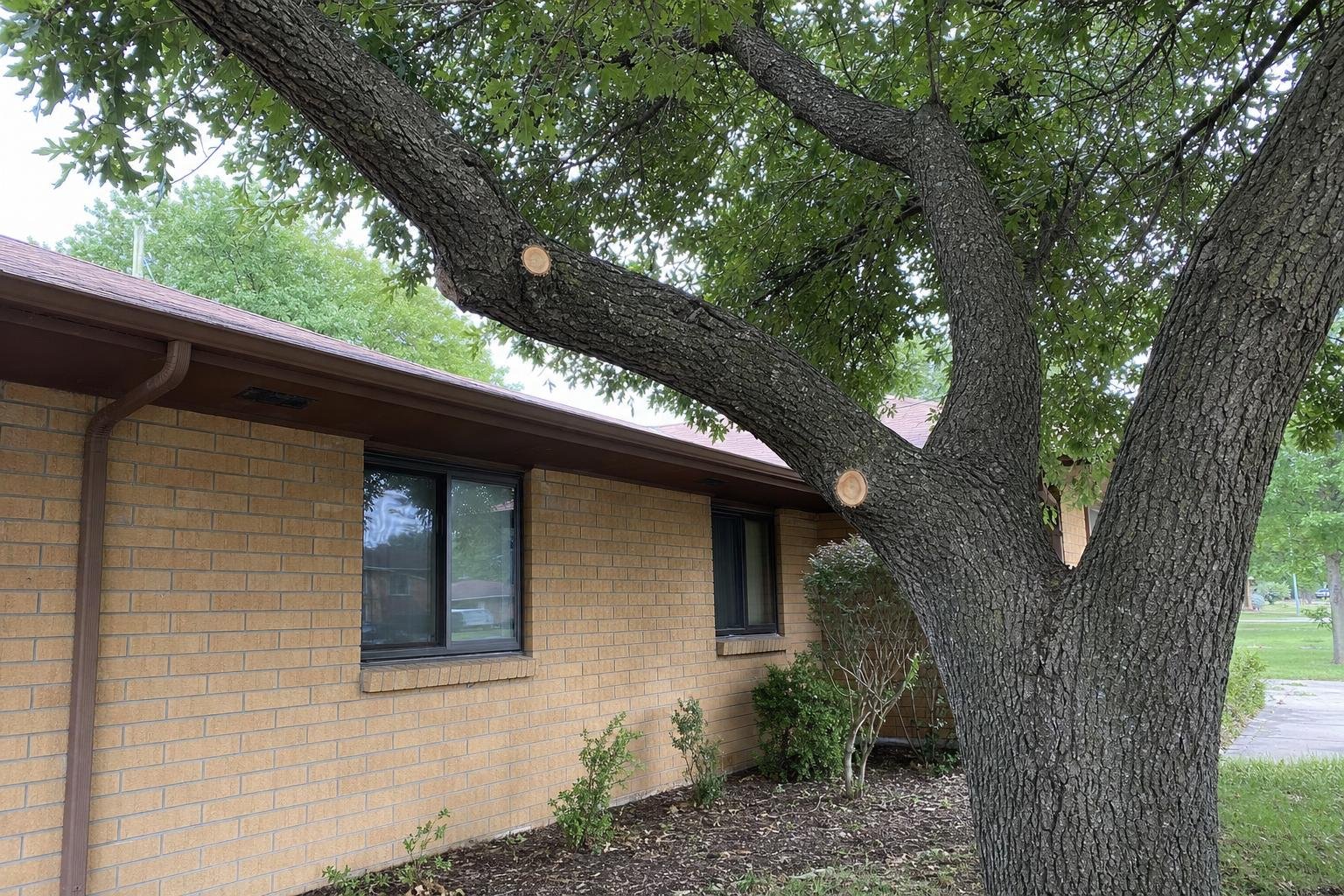
Not if the cuts land where they should. Pruning means taking off dead, crossing or overweight limbs to shape the tree and keep it sound. That is different from a general cutback that just reduces the tree's size. It suits a tree with deadwood, a limb leaning over the roof, or branches rubbing each other. Below: how we make the cuts, what pruning costs per tree, and how Wichita's rain affects the schedule.
Will pruning hurt the tree?
Done right, no. What matters is where each cut lands. We make the final cut just outside the branch collar, the slightly swollen ring where a limb joins the trunk or a larger limb. Cutting flush to the trunk removes tissue the tree needs to close the wound. Leaving a long stub leaves dead wood sticking out where the tree can't seal it.
Large limbs come off in stages. We make an undercut first, then a second cut farther out along the limb to take the weight off. Only then do we make the final cut at the collar. Taking a heavy limb in one pass invites a ragged tear, and a clean cut heals far better than a torn one.
This work can lead into arborist. Looking for tree service in Wichita? See every service we offer.
Worth a read: Budgeting for Tree Service: Real Price Ranges Explained · When a Problem Calls for Tree Service: Signs to Watch
What pruning costs per tree
Pruning runs $175 to $725 per tree. Describe the tree on the phone and we'll tell you where it likely falls in that spread; the final price is set once we've stood under it and looked at the limbs.
A tall tree, limbs big enough to need staged cuts and a rope to lower them, or a canopy that takes more setup to reach pushes the price up. So does a large pile of debris to cut up and haul. A tree with one dead limb and a tree that needs a full clean-up of its structure are different jobs, even if they stand side by side in the same yard.
Our quote reflects the limbs we'll actually be removing, not an average.
Wet seasons and pruning work
Our yearly precipitation totals roughly 34.3 inches. The rainy season runs May through June, with May the wettest month at roughly 5.2 inches. January is the driest at about 0.8 inches.
Rain falls steadily here all year, so wet ground can show up in any season, not just late spring. Soft, soggy turf makes it harder to get equipment and crew across the yard without leaving ruts, and wet limbs and slick footing slow the climbing and cutting. If conditions are poor on the day, we'd rather move the job than rush it and tear up your lawn.
If you see a problem, call when you see it and we'll schedule around the weather.
Protecting the yard while limbs come down
For large branches, we use a rope to lower them in a controlled way instead of dropping them. That keeps the tree, the plants beneath it and your property from being hit or scraped on the way down.
We use a throwline to get the rope up into the canopy, so the rigging goes where we want it without anyone having to climb out to the end of a limb.
Smaller limbs we can cut and drop clear. The rope comes out for the ones with real weight, where a fall could damage a fence, a shrub, a roof edge or the tree itself. We plan which limbs get lowered before anyone makes the first cut.
Signs a tree is due for pruning
Most of the signs are visible from your driveway or back step. Look up for:
- Dead limbs, often bare of leaves when the rest of the tree is full. - Limbs that cross and rub against each other. - Heavy limbs hanging out over the house.
Deadwood and rubbing branches are worth dealing with before they get worse. A heavy limb over the roof goes to the top of our list, since that's where a failure costs the most.
What's Involved
Spelled out, parts of it look like this:
- Identify branches to remove, including dead, diseased, broken, rubbing, or crossing branches.
- Choose a sharp tool suited to the branch size and reach: hand pruners for small twigs, loppers for larger branches, and a pruning saw for larger limbs.
Related Services
Questions Welcome
One phone call is enough to get going, and there's nothing to sign.