
You're not sure whether it's a real problem or just a tree doing what trees do. Here's how we sort that out when we're standing in the yard, and what we tell people before anything gets cut.
Signs worth a call
The ones that get us out there fastest are big damaged branches still attached and hanging over a roof, a driveway or a walkway. A limb that's cracked but hasn't come down yet will let go on its own schedule, and that schedule usually isn't a convenient one. A trunk that has started to lean, or one that's split where two leaders meet, is the other big one. When a tree drops limbs with no wind and no storm behind it, the tree is telling you something. Anything failing within falling distance of the house gets looked at sooner rather than later.
When we take a large branch off, it isn't one cut. We make an underside cut a little way out from the trunk, take most of the branch with a second cut farther out, then finish just outside the branch collar. The underside cut keeps the falling weight from tearing a strip of bark down the trunk. Finishing at the collar, instead of flush to the trunk, leaves the tree the tissue it uses to close the wound.
Over a roof, a fence or a parked car, we don't let pieces fall. We rig them, tie in with carabiners and rope, and lower them under control. How we handle a given tree is decided after walking the site, not guessed at over the phone.
When you are ready, tree trimming is the place to start. Searching for tree service in Wichita? See our home page.
Freeze and thaw effects
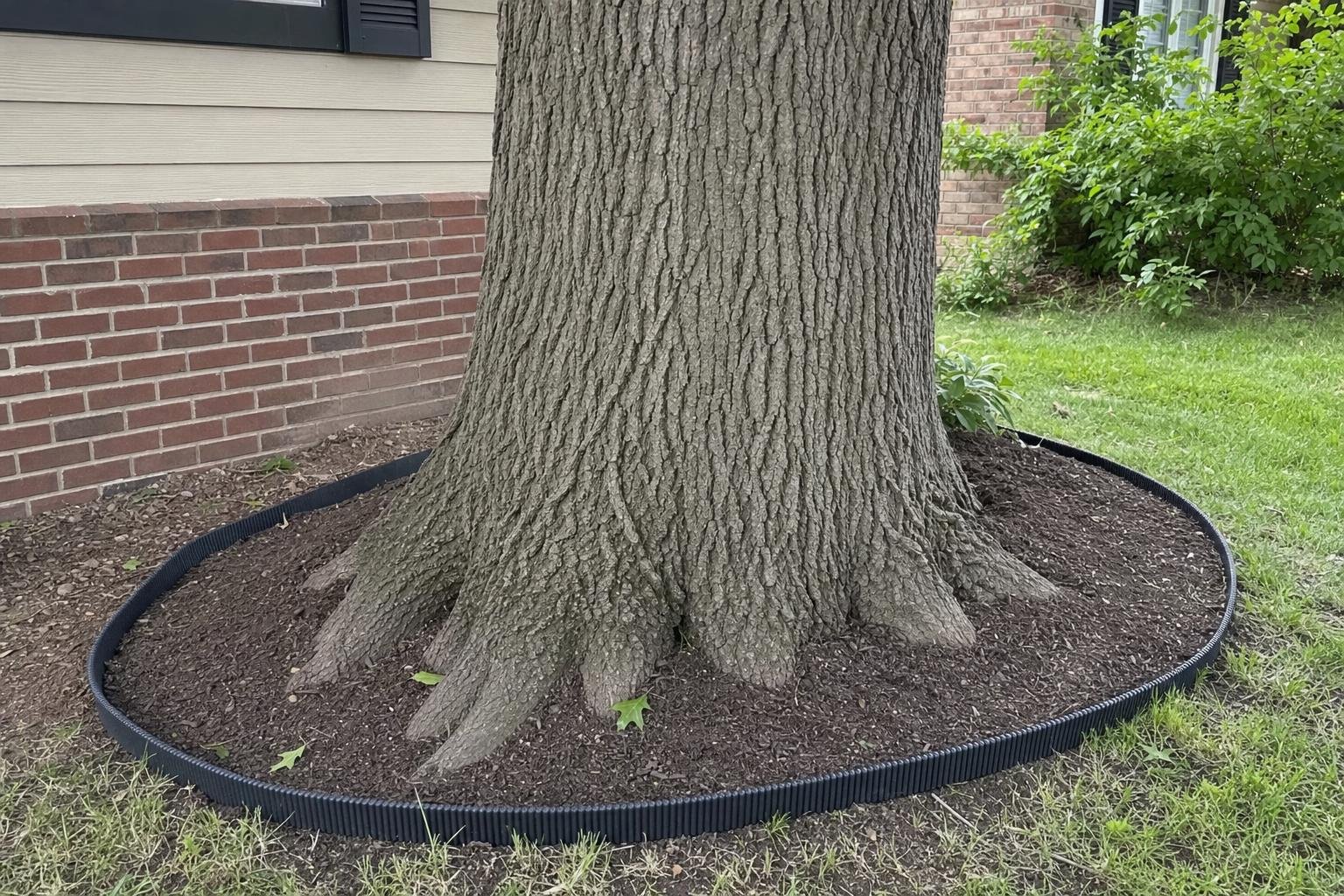
Wichita's hard winter freezes do more than kill a few shrubs. The ground freezes and thaws over and over, and that repeated cycling works on foundations, slabs and pipes alike. The same ground is holding up your trees.
If soil is mounded against one side of a trunk, or the trunk has moved off vertical since last fall, call it in. Same if you see heaving near a slab, a driveway or a foundation. The tree may be fine and the heave may be all you've got, but a lean and heaving together is the combination we don't ignore. It's cheaper to look at it in spring than after a windstorm finishes the job.
Why not leave the stump
Leaving the stump looks like the cheap option on the day and stops looking that way later. A stump in the lawn is in the way of mowing, planting, and putting a shed or a patio where you actually want it. Grinding takes it below grade so you can mow across the spot and use the ground.
Grinders and chippers are the two machines where we're strictest about safety. Guards stay on, emergency stops get checked before we start, and nobody reaches into a chipper's in-feed chute or pushes material in with a hand or a foot. If something jams, the machine stops and we clear it properly. Grinding leaves a hole where the stump was and a pile of grindings, and we tell you about both before we start.
Is the tree yours to remove
Before a permit question, there's a property question. Trees in Wichita's street right-of-way are city-owned and managed by City Forestry. If the tree you want gone sits in that strip, it isn't yours to remove, and we won't cut it just because someone asked us to. Confirm whether a roadside tree is in the right-of-way before arranging removal.
When we come out to look, we check where the tree stands relative to the right-of-way, and if it's a City tree we say so before we talk about anything else. A tree on your own side of the line is a different conversation.
What we charge for small and medium trees
A small tree, under 30 feet, typically runs $900 to $1,800 to remove. A medium tree, 30 to 60 feet, typically runs $900 to $1,800. Ask us for a range like that on the first call; the exact number comes after we've walked the job.
What moves you within a range is everything around the tree: room to drop the wood versus lowering it in pieces, what's underneath it, and how we have to get to it. A dead tree in an open back yard is a different job than a live one leaning over a roof, even at the same height.
Related Services
Fast Scheduling
A quick call is a fine place to start, with no pressure either way.
Updated October 2026